

Picture a merchant galley riding at anchor off the Dalmatian coast in the summer of 1377. The crew can see the walls of Ragusa, the city we now call Dubrovnik, and the harbor where their cargo should be unloading. Nobody is sick or coughing. And nobody is allowed ashore, because on 27 July the republic’s Great Council passed a short law that would change the world: anyone arriving from a place where plague was raging had to wait a month, on the bare rock of Mrkan island or in the little town of Cavtat down the coast, before setting foot in the city.
The clerks copied the decree into the republic’s Green Book, the Liber viridis, where you can still read it. It even punished the locals: any Ragusan who rowed out to greet the travelers, or smuggled them bread, served the same month. A small Adriatic city with no idea what a bacterium was had just invented the fixed-term quarantine. The forty-day version, the one that gave us the word, would follow within a generation.
100% Free · iPad app and web app
Our story Forty Days drops you into Venice in 1348 as Giana, a baker’s daughter with a sick father and no lazaretto to lean on. Flee or stay? Play Black Death Interactive free on iPad or in your browser. Explore Black Death Interactive →
The Ragusan councillors were not scientists. They were merchants, and merchants watch ships. They had seen the Black Death arrive in 1348 on the trade routes that made them rich, and they drew the only conclusion the evidence allowed: the sickness traveled with people and goods. If it came by sea, it could be stopped at sea. Time itself became the filter.

Thirty days was a guess, and a good one. Historians Zlata Blažina Tomić and Vesna Blažina, working through the Dubrovnik archives for Expelling the Plague, show the republic building on that decree for 150 years: officials to enforce it, fines for breaking it, and finally the long stone lazaretto at Ploče that still stands outside the eastern gate. Ragusa got the idea right, then kept it.
Venice, 1348: Commissioners, but No Island to Send Him To
Ragusa’s great rival across the Adriatic had met the plague first, and harder. The Black Death reached Venice early in 1348. On 30 March the Great Council, under Doge Andrea Dandolo, appointed three savi, wise men, to protect public health. They sent boats to carry the dead out to the lagoon islands, policed burials, and tried to control what came in by ship. It was not enough. Something like half the city died, maybe more.

This is the Venice we built for Black Death Interactive. We called the story “Forty Days,” and the title is a deliberate irony, because in 1348 there were no forty days yet. Giana, our fourteen-year-old baker’s daughter, watches her father fall sick in a city with commissioners but no lazaretto, no health board, no certificate to stamp. There is no institution for her to lean on, only her own choice: flee to the countryside, or stay and nurse him.

Bad Air, Angry Planets, and a Very Good Hunch
What did the best minds of 1348 think was killing everyone? In October that year the medical faculty of the University of Paris, asked by King Philip VI for an explanation, delivered its verdict: a conjunction of Saturn, Jupiter and Mars three years earlier had poisoned the air. Rotting vapors rose from swamps and corpses, and whoever breathed them corrupted from the inside. This was miasma theory, inherited from Hippocrates and Galen, and it produced advice that smells wonderful and does nothing: burn juniper, carry sweet herbs, keep your spirits up. Our app sets the theory beside the pathogen profile that actually explains the plague.
Yet ordinary people saw something the professors missed. Boccaccio, describing Florence in the introduction to the Decameron, noticed that merely touching the clothes of the sick seemed to pass the disease on. Quarantine grew out of that second instinct, contagion. You did not need to know about Yersinia pestis, unnamed until 1894, to notice that the plague got off the boat with the sailors.
Why Forty?
Ragusa’s month was a trentino, thirty days. Within a generation the Mediterranean standard had stretched to forty, a quarantino, and the Italian word for the waiting period became the word for the practice. Marseille is often credited with the first forty-day rule in 1383; Venice later wrote forty into the routines of its lagoon islands. Nobody left a memo explaining the number.
Forty was a number a medieval Christian felt in the bones. The Flood rained for forty days. Moses spent forty on Sinai, Christ forty in the desert, and every spring brought the forty days of Lent. Hippocratic doctors taught that an acute disease would show its hand within forty days. And then there was plain experience: an official who watched a traveler fall sick on day twenty-eight of a thirty-day wait wanted a wider margin. Faith, medicine and nerves all pointed the same way.
Islands for the Sick, Islands for the Suspected
Ragusa had the idea first. Venice built the machine. In 1423 the Senate took over the island of Santa Maria di Nazareth in the southern lagoon as a permanent hospital for plague victims. Venetians slurred “Nazareth” into “Lazzaretto,” probably with an assist from Lazarus, patron of the sick, and the word spread to every port in Europe. The island became the Lazzaretto Vecchio: long brick wards, priors, barber-surgeons, and death rates nobody pretended were good.
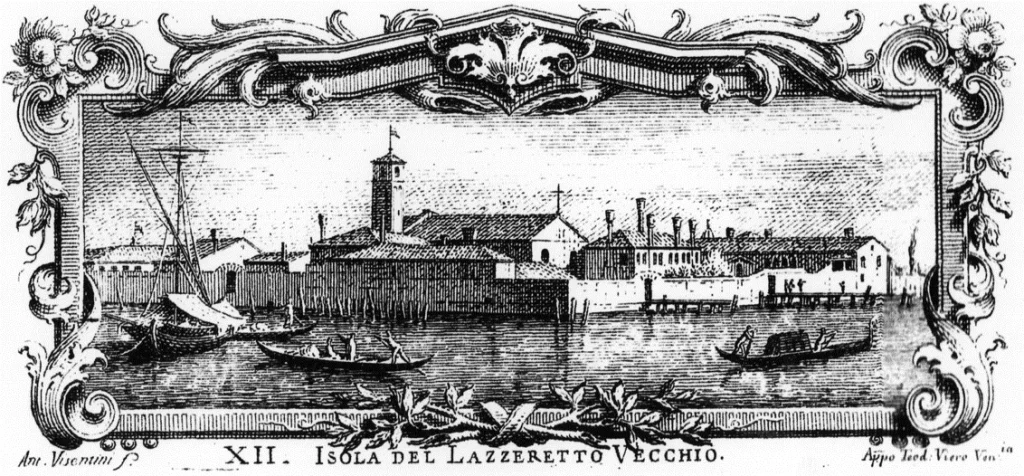
Then came the clever part. In 1468 Venice opened a second island, the Lazzaretto Nuovo, and gave it a different job: not the visibly sick, but the suspected. Crews and cargo from doubtful ports waited out their forty days there, bales of wool and silk were aired in long sheds, and the recovering stopped there before going home. Jane Stevens Crawshaw, whose Plague Hospitals is the standard account, shows these were working institutions with rules, budgets and staff, not simply places to die. Separating the sick from the merely exposed is still the first move in any outbreak.
In 1486 the republic made its health officials permanent. The Provveditori alla Sanità gathered reports from Venetian agents across the Mediterranean, decided which ports counted as infected, and developed the paperwork that grew into the bill of health, a certificate stating where a ship had been and whether plague was present. A captain with a clean bill could unload within days. One without it watched his crew and cargo rowed to the islands. It was passport control for germs, four centuries before anyone had seen one.
Flee Early, Go Far, Come Back Late
Laws and islands tell us what governments did, not what a family faced when the plague walked through the front door. For that, the physicians had three words of Latin: cito, longe, tarde. Flee quickly, go far, come back late. If you owned a villa in the hills, flight was respectable. Boccaccio built the Decameron around ten young Florentines who do exactly that and tell stories while the city dies behind them.
He also recorded, with real bitterness, what flight did to families: brothers abandoned brothers, wives abandoned husbands, and parents refused to tend their own children. Others stayed. Guy de Chauliac, surgeon to the pope at Avignon, admitted he remained only because running would have shamed him; he caught the plague and lived to write about it. Most who stayed left no record. They were the daughters and servants who fetched water, changed sheets and sat with the dying, knowing the nurses died beside their patients.

That is the room Giana stands in. Her father is in the bed. The countryside is a boat ride away, and every physician in Italy is telling her to take it. In Black Death Interactive the story branches on that decision, and later asks her again, on a windswept shore with Venice on the horizon, whether to go back. What would you do? People in 1348 made both choices, and the sources, as the historian Samuel Cohn has shown, record care as well as panic.

Every Quarantine Order Is a Descendant
The men who built this system were wrong about almost everything. Miasma was wrong. The planets were innocent. Rats and fleas were invisible to them. And still they grasped the two facts that mattered: the plague moved along routes that could be watched, and time could be used as a sieve. The historian Carlo Cipolla argued that the Italian health boards ran generations ahead of the rest of Europe, and he was right.
The costs were real. Quarantine wrecked trade, locked up innocent people in grim conditions, and handed officials power over the poor. Those arguments have not changed. But when a cruise ship waited offshore in 2020, when a traveler was told to isolate for a fixed number of days, when a border asked for proof of health, the world was running a program written in the Ragusan Green Book and debugged on two Venetian islands. Every quarantine order on earth descends from that July vote.
100% FREE • GRANT-FUNDED • AWARD-WINNING DIGITAL LEARNING
Black Death Interactive
“Forty Days” puts you in the shoes of Giana, a baker’s daughter in Venice in the plague year of 1348, torn between fleeing to the countryside and staying to nurse her sick father. Built in Unity 3D for iPad and the web. Best of Category winner at the 2024 Horizon Interactive Awards.
Educator tip: Have students read this article, then play Giana’s story in Black Death Interactive and write a one-page petition to the Venetian Great Council of 1348 proposing one public health measure, using the Ragusa decree, the lazarettos or the forty-day rule as their model. Finish with a short reflection on whether Giana would have fled or stayed if that measure had already existed.
Explore Black Death Interactive
Explore the Full History Adventures Portfolio
Al-Khwarizmi Docudrama | Plague of Athens VR | Plague of Athens Web App | Black Death Interactive | Empires & Interconnections | Revolutions & Industrialization
Sources and further reading
- Watch: Disease! Crash Course World History 203 (CrashCourse, YouTube, 2014). John Green on how epidemics, the Black Death included, bend the course of history.
- Watch: Europe on the Brink of the Black Death | Full Episode | The Great Courses (The Great Courses, YouTube). A full lecture on the world the plague found in 1347.
- Play: Black Death Interactive (History Adventures, iPad 2024, web app 2025). Free. Giana’s story “Forty Days,” with maps of the plague’s spread, pathogen profiles, miasma theory and the Decameron.
- Play: A Plague Tale: Innocence (Asobo Studio / Focus Home Interactive, 2019; PlayStation, Xbox, PC, Switch). Pure fiction, with supernatural rat swarms and an Inquisition villain, but a vivid feel for a French countryside emptied by the 1348 plague.
- Listen: Four Hundred Years of Quarantine (The LRB Podcast, 30 March 2020). Historian Erin Maglaque on Venice’s lazarettos, Florence’s 1631 lockdown and what they share with 2020.
- Read: Giovanni Boccaccio, The Decameron, Introduction to the First Day (1353). The best eyewitness account of 1348 Florence, free on Project Gutenberg.
- Read: John Kelly, The Great Mortality: An Intimate History of the Black Death (HarperCollins, 2005). The readable popular history, built from letters, chronicles and diaries.
- Read: Jane L. Stevens Crawshaw, Plague Hospitals: Public Health for the City in Early Modern Venice (Ashgate, 2012). The scholarly standard on the lazzaretti and the people who ran them.
Featured image: Francesco Guardi, Venice from the Bacino di San Marco, oil on canvas, ca. 1765-75, cropped to 16:9. The Metropolitan Museum of Art, New York, Open Access. Public domain.
By Spencer Striker, PhD, Professor of Digital Media Design at Northwestern University in Qatar, founding member of NU-Q’s Artificial Intelligence and Media Lab (AIM-LAB), and creator of History Adventures and Al-Khwarizmi: Father of Algebra & the Algorithm.