
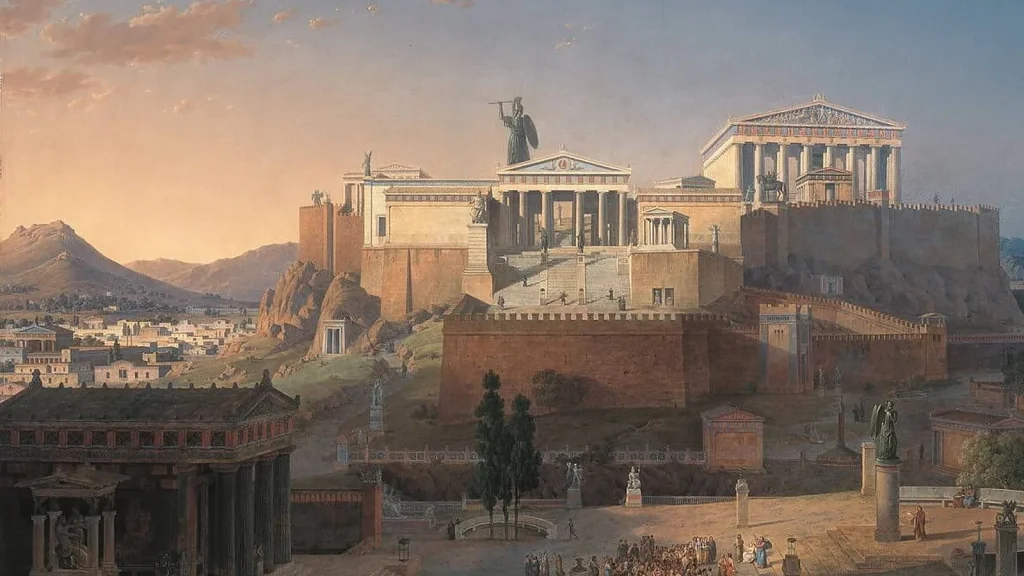
In the early summer of 430 BCE a sickness broke out in Piraeus, the harbor town of Athens, and no one could put a name to it. Within days people were dying by the docks, and soon after in the upper city. It was the second year of the Peloponnesian War. A Spartan army was burning the farms of Attica, and on the advice of Pericles the country people had abandoned their land and crowded inside the city walls, trusting the fleet to feed them and the fortifications to keep them safe. The walls kept out the Spartans. They also kept in the sick.
By 429 the disease had reached the household of Pericles himself. His sons Xanthippus and Paralus died of it, and in the autumn of that year Pericles followed them, worn down, according to Plutarch, by a slow and lingering form of the same illness. The epidemic faded, then returned in the winter of 427 and ran on into 426. Thucydides counted 4,400 hoplites and 300 cavalrymen among the dead and admitted that the losses among everyone else, the poor, the women, the enslaved, and the refugees in their shacks, could never be reckoned.
100% Free · Meta Quest · Steam VR · Pico VR · Chromebook Web App
Want to walk the plague-struck streets Thucydides describes? Plague of Athens: VR puts students in the sandals of Nikos, a young physician in 429 BCE, and the Chromebook Web App brings the same story to classrooms without headsets. It is completely free. Explore Plague of Athens →
We know the course of the disease so well because one of its victims lived to describe it. Thucydides, son of Olorus, caught the sickness, recovered, and set down in the second book of his History of the Peloponnesian War an account that physicians have argued over for more than two thousand years. In the last three decades laboratories have joined the argument. Teeth from a mass grave beside the Kerameikos cemetery have been tested for ancient DNA, and the result, far from closing the case, has reopened it.
A city behind its walls
Pericles’ strategy was simple and, on paper, sound. Athens could not defeat Sparta on land, so it would not try. The rural population of Attica would withdraw inside the fortifications, which joined the city to Piraeus by two parallel Long Walls roughly six kilometers in length. Grain would come by sea, and the navy would raid the coasts of the Peloponnese while the Spartan infantry wasted its strength on empty fields.
The cost of the plan fell on the people who had to carry it out. Thucydides describes families who arrived to find no houses waiting for them and lived instead in stifling huts through the hottest months of the year. Some camped in temples and shrines. Others settled in the narrow corridor between the Long Walls. Water came from cisterns and a limited number of public fountains, and sanitation in a Greek city was rudimentary even in peacetime. Into this crowd the sickness arrived.
A witness, not a physician
Thucydides begins with geography. The disease, he writes, was said to have started in Ethiopia, beyond Egypt, and to have passed into Egypt, Libya, and much of the Persian king’s territory before it fell without warning on Piraeus. Because the first deaths came at the harbor, a rumor spread that the Peloponnesians had poisoned the cisterns, for Piraeus had no fountains at the time. Thucydides repeats the rumor and moves on. He shows little interest in blame.
He is just as restrained about causes. He leaves it to others, physicians or laymen, to explain where the disease came from and what could have thrown the body into such disorder. His own aim was narrower and, as it turned out, more durable. He would describe the disease exactly, so that anyone who studied the symptoms would recognize it if it ever returned. He had suffered it himself, he adds, and had watched others suffer. Few ancient historians tell us so plainly why we should believe them.
What Thucydides saw
The first signs
People in good health were struck without warning. The first sign was a violent heat in the head, with redness and inflammation of the eyes. The throat and tongue turned bloody, and the breath became unnatural and foul. Sneezing and hoarseness followed, and before long the trouble descended into the chest with a hard, racking cough. When it settled in the stomach it brought on vomiting of every kind of bile the doctors had a name for, with great distress. Most patients then suffered an empty retching, the Greek lynx kenē, which some modern physicians read as hiccups, along with violent convulsions that passed quickly in some cases and lingered far longer in others.
The order matters. Thucydides traces the illness downward through the body, from the head to the chest, from the chest to the stomach, and finally to the bowels, as a soldier might trace the advance of an enemy through a captured town.
The burning
To the touch the body was not especially hot, nor was it pale. The skin was reddish and livid and broke out in small blisters and sores. Inside, the patients burned. They could not bear even the lightest clothing or linen and wanted nothing more than to throw themselves naked into cold water. Many who had no one to watch over them did exactly that, plunging into the rain cisterns in a thirst that no amount of drinking could relieve. They could not rest, and they could not sleep.
The strangest detail is that the body did not waste away while the fever was at its height. It held out beyond anyone’s expectation, so that most victims died on the seventh or ninth day with some strength still in them, consumed, as Thucydides understood it, by the heat within. Those who survived that crisis faced a second one. The disease descended into the bowels, bringing severe ulceration and uncontrollable diarrhea, and many died afterward from the weakness it left behind.
The marks it left
Even where the sickness did not kill, it left its signature. In survivors it fastened on the extremities. Some lost fingers and toes, some their genitals, and some their eyes. Others rose from their beds with no memory at all, unable to recognize themselves or their friends. Modern readers have taken the first group of symptoms for gangrene caused by damage to small blood vessels, and the second for the aftermath of a high fever acting on the brain. Thucydides offers no such explanations. He records what he saw and lets the record stand.
Birds, dogs, and nurses
Two further observations have become central to the modern debate. The first concerns animals. Birds and beasts that feed on human flesh, Thucydides writes, either kept away from the unburied bodies or died after tasting them. Carrion birds vanished from the city altogether, and the effect was easiest to observe in dogs, which lived alongside people.
The second concerns contagion. Those who nursed the sick caught the disease and died “like sheep,” and this, more than anything, drove up the toll. Families too frightened to visit one another died alone. Families who did visit died together. Only those who had already recovered could tend the dying with some confidence, because no one, Thucydides says, caught the disease a second time, or at least not fatally. It is among the earliest descriptions in Western literature of acquired immunity, written more than two thousand years before anyone could explain it.
Thucydides says the physicians died fastest of all, because they went where the sickness was. That is the world of Nikos of Athens, the young physician at the center of Plague of Athens: VR. He has sworn by Apollo the Physician and by Asclepius to help the sick and keep them from harm, yet every house he enters may be the one that kills him, and the god he swore by seems deaf to the city’s prayers. Put yourself in his sandals in the summer of 429 BCE, standing at the door of a stranger’s hut between the Long Walls. Do you go in, knowing what happened to the doctors before you? Or do you keep yourself alive so that you can treat someone tomorrow?
When custom gave way
The collapse of social order troubled Thucydides as much as the suffering of the body. The dying lay heaped on one another in the streets and gathered, half dead, around the fountains in their craving for water. The temples where refugees had camped filled with corpses. Burial, one of the most binding obligations in Greek life, broke down. Some families, short of fuel, laid their dead on a pyre that others had built and set it alight before the builders returned. Others threw a body onto a pyre already burning and walked away.
Law and religion lost their hold for a reason Thucydides states plainly. People watched the pious and the impious die alike, and no one expected to live long enough to stand trial. Men spent their money quickly on pleasure, reasoning that both wealth and life were borrowed for a day. Honor seemed a poor investment when no one knew whether he would survive to collect on it. Thucydides does not preach. He reports these things as he would report the loss of a fleet, because for a democracy that depended on the willing restraint of its citizens, they amounted to the same kind of defeat.
Old prophecies were remembered. The elders recalled a verse which said that a Dorian war would come, and a plague with it. Some argued that the original word had been limos, famine, rather than loimos, plague. Naturally, Thucydides observes, people settled on plague, since memory bends itself to present suffering. If another Dorian war ever came, he adds, and brought a famine this time, they would no doubt recite the verse the other way.
The pit by the Kerameikos
For most of history the plague of Athens existed only in Thucydides’ pages. That changed in 1994 and 1995, when construction work for the Athens metro near the ancient Kerameikos cemetery exposed a mass grave. The archaeologist Efi Baziotopoulou-Valavani led the excavation. The pit held the remains of roughly 150 people, laid in irregular layers with little of the ceremony Athenians normally gave their dead and accompanied by only a scattering of small vases. The pottery dates the burial to the years around 430 to 426 BCE, the span of the epidemic.
In 2006 a team led by Manolis Papagrigorakis of the University of Athens published an analysis of dental pulp from individuals in the pit. Pulp is a promising archive, sealed inside the tooth and fed by blood during life. The team reported DNA sequences matching Salmonella enterica serovar Typhi, the bacterium that causes typhoid fever. A few years later the same researchers used one of the skulls to reconstruct the face of an eleven-year-old girl they called Myrtis, who has since become the public face of the Athenian dead.
The typhoid claim met resistance at once. Beth Shapiro, Andrew Rambaut, and M. Thomas P. Gilbert argued that the published sequences did not clearly distinguish Typhi from related Salmonella strains, and that the PCR methods then in use on ancient material were notoriously vulnerable to modern contamination. Papagrigorakis and his colleagues defended their findings. No independent laboratory has since recovered a complete pathogen genome from the Kerameikos dead, and the identification remains unconfirmed.
Three leading diagnoses
Over the centuries scholars have proposed some thirty candidates for the disease. Smallpox and measles have had serious champions, while bubonic plague has been set aside by most because Thucydides never mentions the swollen lymph nodes that give it its name. Every candidate must answer to his description, and none answers to all of it. Three hypotheses now carry the most weight.
| Typhoid fever Salmonella enterica Typhi |
Epidemic typhus Rickettsia prowazekii |
Viral hemorrhagic fever an Ebola-like virus |
|
|---|---|---|---|
| Fit with Thucydides | Fever, prostration, and a late intestinal phase with ulceration and diarrhea match the bowel stage closely. Confusion and delirium are common. | Sudden high fever, red eyes, rash, delirium, and memory loss fit well. Gangrene of fingers, toes, and genitals is a known complication. | Bloody throat, red eyes, intense inner heat, retching or hiccups, and death within about a week match well. Proposed by Patrick Olson and colleagues in 1996. |
| How it spreads | Contaminated water and food. Refugees sharing cisterns inside the walls are an ideal setting. | Body lice, which thrive in war, siege, and overcrowding. Nurses and physicians would be heavily exposed. | Close contact with blood and bodily fluids, which would explain the deaths among caregivers. The Ethiopian origin Thucydides reports points toward Africa. |
| Animals and immunity | Does not explain the deaths of carrion birds and dogs. Recovery gives partial protection against reinfection. | Does not explain the scavenger deaths. Survivors gain strong immunity, though the infection can recur years later in a milder form. | A virus lethal to other species could account for the scavengers, though the evidence for birds is thin. Survivors are generally immune. |
| Laboratory evidence | The only candidate with published ancient DNA from the Kerameikos pit (Papagrigorakis and colleagues, 2006). Disputed and not independently replicated. | No rickettsial DNA has been reported from the pit. The case rests on symptoms and setting. | None. RNA viruses rarely survive in archaeological remains, so the absence of evidence proves little. |
| Main weakness | Typhoid usually runs three to four weeks and kills late. Death on the seventh or ninth day is fast for it, and its faint rose spots are not blisters. | Thucydides never mentions lice, and the throat and stomach symptoms he stresses are less typical of typhus. | Hard to sustain in one city across four years, and no comparable ancient epidemic in Africa is documented. |
What the DNA can and cannot tell us
Ancient DNA has transformed the study of past epidemics. The bacterium behind both the Plague of Justinian and the Black Death, Yersinia pestis, has been identified beyond reasonable doubt from genomes recovered in burial pits across Europe. The Athenian case shows the limits of the method as clearly as its promise.
Even a secure identification from a single grave would prove only that a pathogen was present in some of the dead. It could not show that every death across four years came from one organism. Besieged cities breed several diseases at once, and Thucydides himself remarks that whatever other illness anyone had that year seemed to turn into this one. Typhoid could have travelled alongside typhus, or followed in the wake of something else entirely.
The standards of the field have also risen since 2006. Researchers now expect whole-genome sequencing, chemical damage patterns showing that the DNA is genuinely ancient, and confirmation from a second laboratory working independently. These were not yet routine when the Kerameikos teeth were tested. And the hemorrhagic hypothesis may never be testable this way at all, because the RNA viruses at its center decay far faster than bacterial DNA. A silent result from the teeth would not clear them. It would only mean that teeth were the wrong archive.
For now, then, the laboratory has given us a lead rather than a verdict. That is still a great deal more than earlier generations had. For centuries the debate rested on a single Greek text. Today there is a grave, a date, a set of remains, and at least one molecular claim waiting to be tested again.
Why the argument still matters
Thucydides bound the plague to the fortunes of the war. It killed Pericles, the one leader whose authority could hold the Athenian assembly to a cautious strategy, and it left the city to the men who came after him, whose rivalries and ambitions led in time to the catastrophe in Sicily. By modern estimates it killed between a quarter and a third of the population of Attica. And it taught a generation of Athenians that piety and restraint protected no one, a lesson Thucydides suggests the city never entirely unlearned.
He wrote his description so that later readers would know the disease if it came again. In a sense the experiment is still running. Every new hypothesis is measured against his account, and every laboratory result must explain the burning heads, the red eyes, the bloody throats, the blistered skin, the thirst that water could not quench, the vanished birds, and the survivors who woke without their memories. Science may one day name the microbe. It will still need the witness.
100% FREE • GRANT-FUNDED • AWARD-WINNING DIGITAL LEARNING
Plague of Athens: VR & Plague of Athens: Web App
Step into the sandals of Nikos of Athens, a young physician in 429 BCE whose Hippocratic Oath and faith in Apollo are tested as the plague tears through his city. Play in VR on Meta Quest, Steam VR, and Pico VR, or use the Plague of Athens: Web App on Chromebooks in classrooms without headsets.
Educator tip: Assign this article as the primary-source briefing, then have students play Plague of Athens and log every choice Nikos makes against what Thucydides reports in 2.47 to 2.54. Close with a short written defense of one decision using evidence from both.
Get it on Meta Quest Get it on Steam VR Pico VR & Chromebook Web App
Explore the Full History Adventures Portfolio
Al-Khwarizmi Docudrama | Plague of Athens VR & Chromebook Web App | Black Death Interactive (iPad) | Empires & Interconnections (iPad, Apple Books, Android) | Revolutions & Industrialization (Apple Books & Chromebook)
Sources and further reading
- Thucydides, History of the Peloponnesian War, 2.47 to 2.54 and 3.87.
- Plutarch, Life of Pericles, 36 to 38.
- Manolis J. Papagrigorakis and colleagues, “DNA examination of ancient dental pulp incriminates typhoid fever as a probable cause of the Plague of Athens,” International Journal of Infectious Diseases (2006).
- Beth Shapiro, Andrew Rambaut, and M. Thomas P. Gilbert, “No proof that typhoid caused the Plague of Athens,” International Journal of Infectious Diseases (2006).
- Patrick E. Olson and colleagues, “The Thucydides syndrome: Ebola déjà vu?” Emerging Infectious Diseases (1996).
- Robert J. Littman, “The Plague of Athens: Epidemiology and Paleopathology,” Mount Sinai Journal of Medicine (2009).
Featured image: Leo von Klenze, Ideal View of the Acropolis and the Areopagus in Athens, 1846, oil on canvas, an imagined reconstruction of the ancient city. Neue Pinakothek, Munich. Public domain, via Wikimedia Commons.
By Spencer Striker, PhD, Professor of Digital Media Design at Northwestern University in Qatar, founding member of NU-Q’s Artificial Intelligence and Media Lab (AIM-LAB), and creator of History Adventures and Al-Khwarizmi: Father of Algebra & the Algorithm.