
Summer, 429 BCE. A young Athenian physician stands at the door of a mud-brick hut wedged between the Long Walls, where country families have camped since the Spartans burned their farms. Inside, someone is burning with fever and begging for water. He knows what happened to the last doctors who walked through doors like this one. Thucydides, who caught the disease himself and lived, says the physicians died fastest of all, because they went to the sick most often.
The young man has sworn an oath. He swore it by Apollo the Physician and by Asclepius, and he promised to work for the good of the sick and keep them from harm. Apollo, though, is also the god who shot a plague into the Greek camp at Troy with his silver bow. So the question at the door is not only medical. Will his craft save anyone? Will his gods? In the summer of 429 the honest answer to both was no, and that collision is the story of this post.
100% Free · Meta Quest, Steam VR, Pico VR, and a Chromebook web app for classrooms without headsets
Want to stand in that doorway yourself? In Plague of Athens: VR and our Chromebook web app you play Nikos of Athens, a young physician whose Hippocratic Oath and faith in Apollo are tested as the plague tears through his city. Both are completely free. Explore Plague of Athens VR →
The oath that doctors still swear
We built Nikos of Athens, the physician at the heart of our Plague of Athens: VR and our Chromebook web app, to live inside that doorway. His faith in Apollo and the meaning of his Hippocratic Oath are both tested as the city comes apart. Before we follow him in, it is worth knowing what the oath actually says, because almost everyone has heard of it and almost no one has read it.

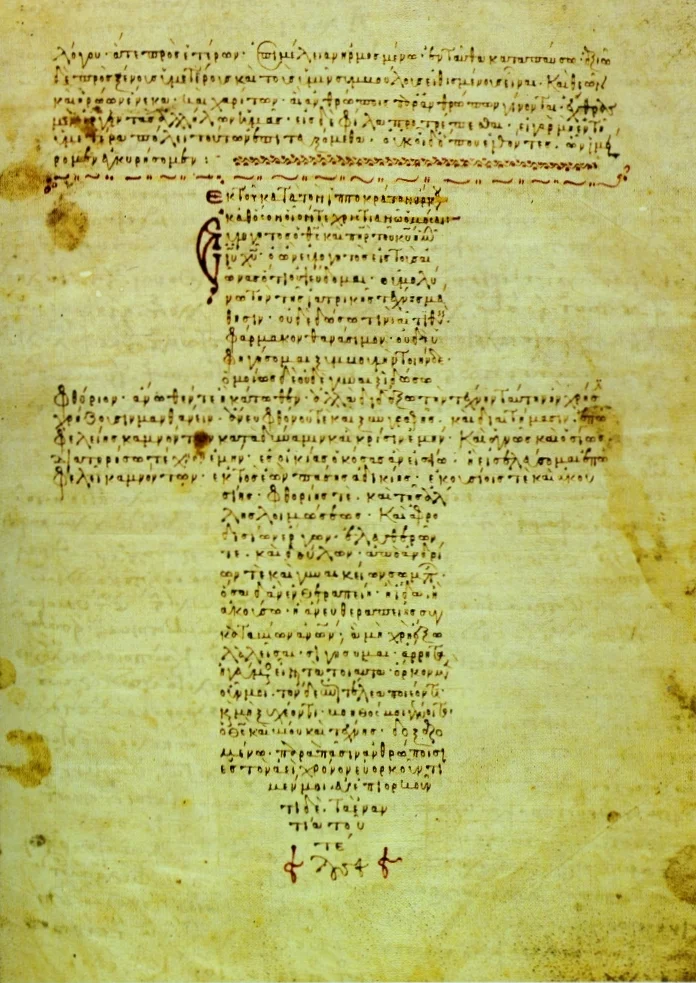
It opens with a roll call of gods: Apollo the Physician, Asclepius, Hygieia, Panacea, and every god and goddess as witness. Then come the promises. Honor the teacher who trained you as you would a parent. Use diet and treatment for the good of the sick and never to hurt them. Give no deadly drug to anyone who asks, and do not suggest one. Leave cutting for bladder stones to the specialists. Enter every house only to help, with no injustice and no seduction of anyone inside. And whatever you see or hear in the course of your work, keep it to yourself.
Two things surprise modern readers. The phrase “first, do no harm” is not in it. And the oath leans hard on the gods, with no hint of a doctor who has given up on them. Its exact date and author are debated, somewhere in the late fifth or fourth century BCE, and most ancient doctors probably never swore it. What matters is the idea: a healer who binds himself, in public and under the gods, to an ethic of care. Twenty-four centuries later, graduating medical students still stand up and recite a version of it.
The revolution: disease has a cause, and the cause is nature
The famous line about harm comes from a different book in the same collection. The Epidemics, written by doctors working on the island of Thasos and elsewhere, tells the physician to make a habit of two things in disease: to help, or at least to do no harm. That is the voice of a working clinician, and it is the real revolution.
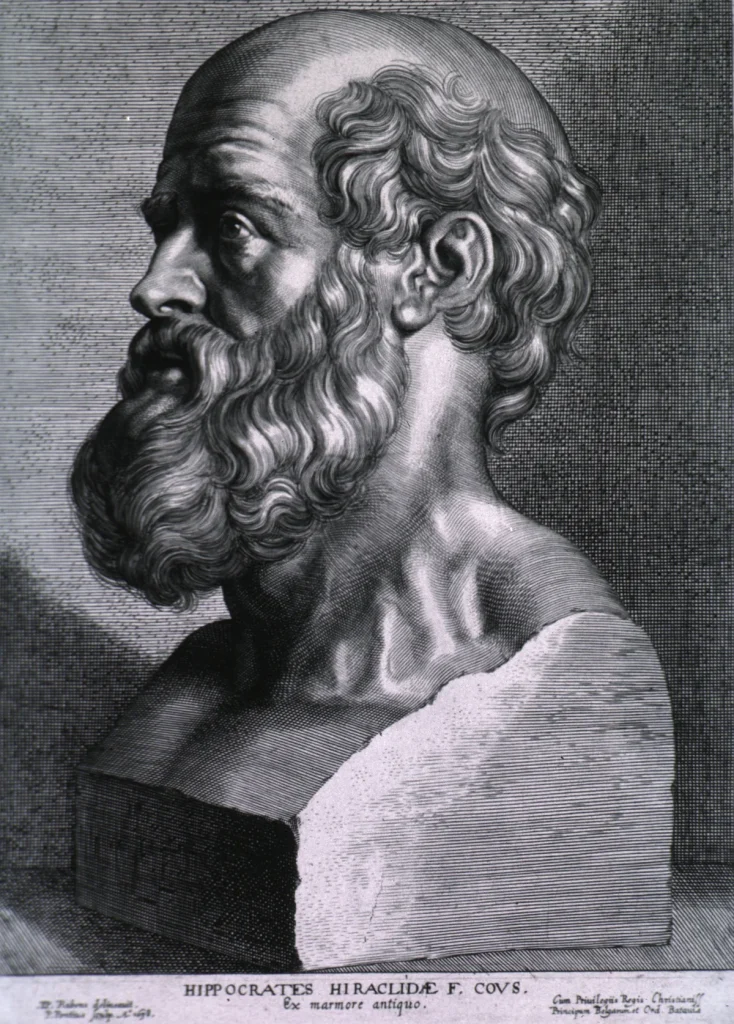
Hippocrates of Kos was born around 460 BCE, a generation before the plague, and he was already famous when Plato wrote about him. Some sixty treatises survive under his name, written by many hands over several generations, and together they do something no one had done before. They write down the patient. Philiscus, who lived by the city wall, took to his bed with a fever, and the writer follows him day by day through sweats, sleeplessness and delirium until he dies within the week. Many of his patients die, and he says so. The point was not to boast but to learn what a disease does, so you could tell a family what was coming.
That skill was called prognosis, and it was the Hippocratic doctor’s calling card. A second treatise, On the Sacred Disease, goes further. Epilepsy, it says, is no more sacred than any other illness. It starts in the brain, it has a natural cause like everything else, and the charm-sellers who call it divine are hiding their ignorance. Study the winds, the water, the seasons and the way people live, says Airs, Waters, Places. The gods are not denied. They simply stop being the explanation.
Across the street, the god was taking patients
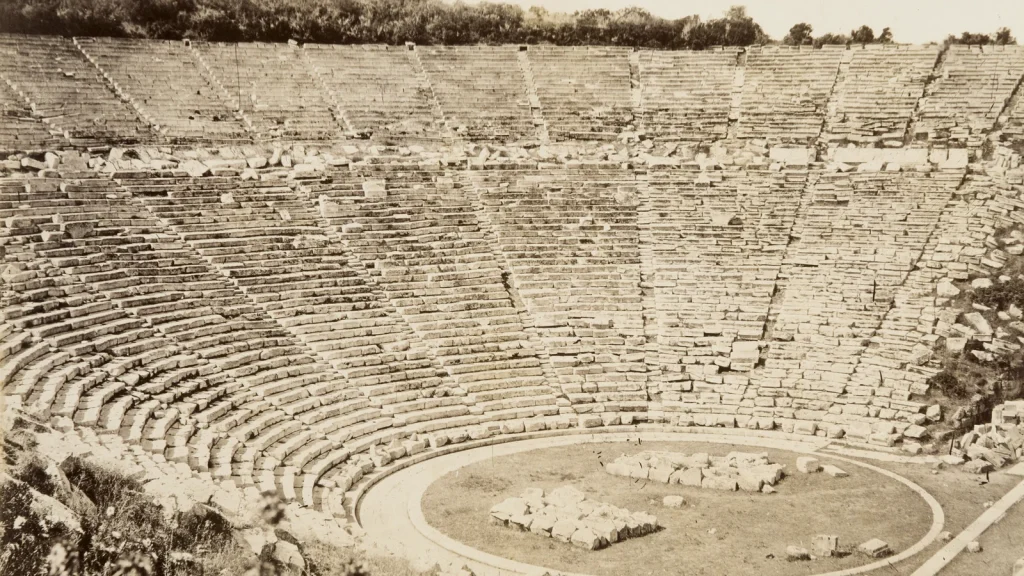
Now cross the street, because most Greeks did. At Epidaurus in the Peloponnese, the sanctuary of Asclepius grew into one of the great holy places of the Greek world, with a temple, a round tholos, a sleeping hall called the abaton, and the theatre in our featured image, which still fills with audiences every summer.
The treatment was called incubation. You washed, you sacrificed, you lay down in the abaton, and you waited for the god to come to you in a dream. Sometimes he operated. Sometimes a sacred snake licked the wound. In the morning you told the priests what had happened, and the best stories were carved in stone. These cure inscriptions, the iamata, still survive. Kleo had been pregnant for five years; she slept in the abaton and gave birth to a boy who walked straight to the fountain and washed himself. Ambrosia of Athens, blind in one eye, laughed at the cures as she read them. The god healed her in her sleep and asked for a silver pig in return, as a memorial of her ignorance.

This was not fringe medicine. It was popular, organized and growing in exactly the decades the Hippocratic doctors were writing, and the two sides did not see each other as enemies. The doctors of Kos called themselves Asclepiads, sons of Asclepius, and the oath begins with his name. In 420 or 419 BCE, a few years after the plague, a citizen named Telemachus brought the god to Athens and founded a sanctuary for him on the south slope of the Acropolis, a short walk from the streets where the plague had done its worst.
The summer when nothing worked
Back to the doorway in 429. Thucydides sets the two failures side by side in a single passage. The physicians were helpless, he says, because they were treating a disease they did not know, and they died in the greatest numbers because they visited the sick most. Prayers in the temples, appeals to oracles and the rest were just as useless, and in the end people gave them up. A few chapters later he adds the detail that haunts the whole account: the pious and the impious died alike.
The god of the oath was in the air too. Every Athenian knew that the Iliad opens with Apollo’s arrows bringing plague to the Greek army. Before the war, the oracle at Delphi had promised the Spartans that the god would fight on their side, and Athenians remembered that promise as the sickness burned through their city while the Peloponnese went largely untouched.

This is the moment we built Nikos for. In our VR he walks the Athenian streets, enters the villa of the wealthy Calyx, and travels to the Oracle of Delphi, carrying an oath sworn by Apollo through a plague that Apollo does not stop. In the Chromebook web app, the oath itself sits in front of students as an interactive primary document, next to Thucydides’ account of the plague, so they can read what Nikos swore before they decide what he should do. Standing at that door, with the fever inside and the dead doctors behind you, what would you do?

Why the oath won
Here is the stand we take. The Hippocratic method and the oath were revolutionary not because they beat the gods in 429 BCE. They did not; nothing did. They were revolutionary because they offered a different kind of promise. The temple promised a cure, if the god chose to give one. The oath promised conduct: I will watch closely, I will tell you the truth about what is coming, I will not poison you, I will not use your house or your secrets against you, and I will try to help, or at least do no harm.
That promise could survive a plague. A doctor who could not save anyone in 429 could still keep every clause of it, and the physicians who died at bedsides that summer were, in Thucydides’ telling, doing exactly that. Asclepius got his sanctuary on the Acropolis a few years later, and Athenians kept sleeping in his abaton for centuries. But when medicine finally learned why fevers kill, it was the Hippocratic habit of looking, writing down and predicting that it built on. The oath came along for the ride, carried by people who understood that the first revolutionary act in medicine was not a cure. It was a promise.
100% FREE • GRANT-FUNDED • AWARD-WINNING DIGITAL LEARNING
Plague of Athens: VR and Plague of Athens: Web App
Step into the sandals of Nikos of Athens, a young physician in 429 BCE whose Hippocratic Oath and faith in Apollo are tested as the plague tears through his city. The VR edition won a Davey Award Gold for Best Immersive Experience and a Reimagine Education Bronze Medal in 2024. The Chromebook web app, an Anthem Award medalist, brings the same story to any classroom with a browser.
Educator tip: Have students read the Oath in the web app and Thucydides 2.47 to 2.54, then play as Nikos and keep a short case journal in the style of the Hippocratic Epidemics: symptoms observed, prognosis given, decision made. Finish with a one-page argument on whether Nikos kept his oath, citing the Oath, Thucydides and one choice from the game.
Explore Plague of Athens VR Explore the Chromebook Web App
Explore the Full History Adventures Portfolio
Al-Khwarizmi Docudrama | Plague of Athens VR | Plague of Athens Web App | Black Death Interactive | Empires & Interconnections | Revolutions & Industrialization
Sources and further reading
- Play: Plague of Athens: VR (History Adventures, 2023, Meta Quest, Steam VR and Pico VR) and the Plague of Athens web app (2022, Chromebook and desktop Chrome). Step in as Nikos and read the Oath and Thucydides as interactive primary documents. Free.
- Watch: Pandemics in history: The Plague of Athens (FRANCE 24 English, YouTube). A short, sharp broadcast segment on the outbreak Thucydides described.
- Watch: Sanctuary of Asclepius at Epidaurus, Greece – World Heritage Journeys (World Heritage Journeys, YouTube). A walk through the healing sanctuary, the abaton and the theatre in our featured image.
- Listen: The Hippocratic Oath, In Our Time, BBC Radio 4 (2011). Melvyn Bragg with Vivian Nutton, Helen King and Peter Pormann on what the Oath says, who wrote it, and who actually swore it.
- Listen: 078: Healing and Medicine, The History of Ancient Greece Podcast (2018). Asclepius, the sanctuaries, Hippocrates and the Hippocratic Corpus in one episode.
- Read: Thucydides, History of the Peloponnesian War, Book 2, chapters 47 to 54 (Perseus Digital Library). The plague, the useless prayers, the doctors who died first.
- Read: Hippocrates, The Oath, translated by Francis Adams (Perseus Digital Library). The whole text takes two minutes.
- Read: Vivian Nutton, Ancient Medicine, second edition (Routledge, 2013), the standard survey; for a fast, friendly start, Helen King, Greek and Roman Medicine (Bristol Classical Press, 2001).
Featured image: the theatre in the Sanctuary of Asclepius at Epidaurus, in a photograph by an unknown photographer titled Hieron d’Epidaurus. Le Théâtre, from the von Hallwyl family’s 1896 travel album of Greece. Hallwyl Museum (Hallwylska museet), Stockholm. Public domain, via Wikimedia Commons.
By Spencer Striker, PhD, Professor of Digital Media Design at Northwestern University in Qatar, founding member of NU-Q’s Artificial Intelligence and Media Lab (AIM-LAB), and creator of History Adventures and Al-Khwarizmi: Father of Algebra & the Algorithm.