
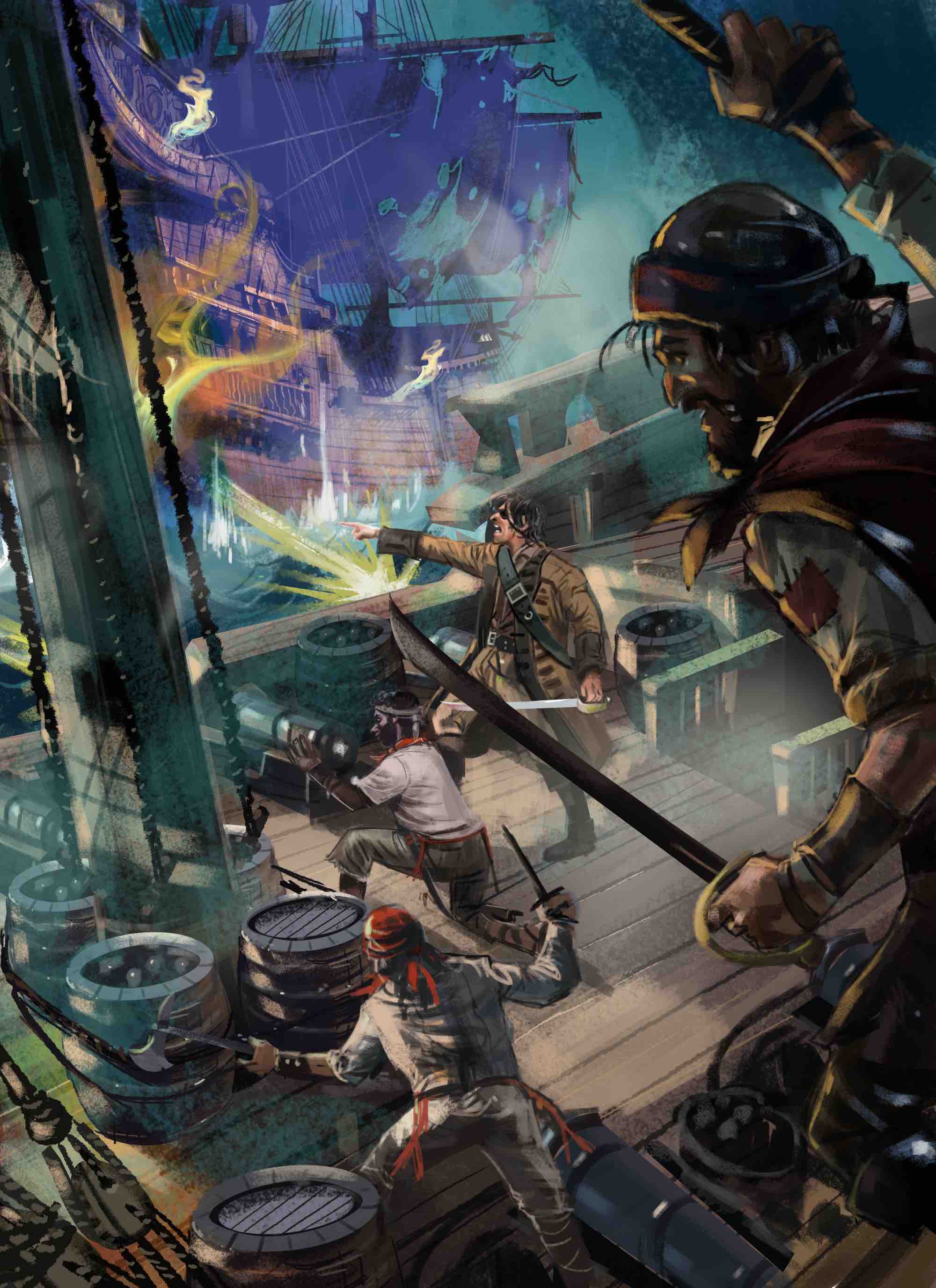
Nassau harbor, late July 1718. Royal Navy warships lie off the bar, and aboard one of them Woodes Rogers, the new royal governor of the Bahamas, is waiting for daylight to take possession of the most lawless town in the Americas. Then, out of the dark, something comes drifting toward his squadron: a captured French ship, sails set, decks stacked with powder, burning from stem to stern. Charles Vane has turned a prize into a fireship.
While the navy cuts its cables to escape the flames, Vane’s sloop slips out through the harbor’s other channel, flying the black flag and firing a parting salute at the king’s ships. Behind him, several hundred pirates on the beach are deciding, in one night, whether to take the pardon Rogers has brought or to follow Vane out to sea. This is the moment the Starz series Black Sails spent four seasons building toward. It really happened.
100% Free · iPad app, Android tablet app, and Apple Books interactive edition
Want to stand on that Nassau beach and make the call yourself? In our free app Empires & Interconnections (1450-1750), Jonas lives free in the Republic of Pirates, plunders ships, and tries to keep his crew loyal and his neck out of the noose. Explore Empires & Interconnections →
The show that took pirates seriously
Black Sails (Starz, 2014 to 2017) was pitched as a prequel to Treasure Island, set twenty years before Stevenson’s novel, and it could have been another cutlass-and-cursed-gold romp. Instead the creators, Jonathan E. Steinberg and Robert Levine, made the anti-Pirates of the Caribbean: no sea monsters, no curses, no comic drunk. Their Nassau is a working port where the business of piracy is selling stolen sugar and arguing over shares.

What makes the show special is that its fictional characters walk into a real history. Captain Flint and John Silver come from Stevenson, but Charles Vane, Jack Rackham, Anne Bonny, Benjamin Hornigold, Blackbeard and Woodes Rogers were all real, and all really in the Bahamas between 1715 and 1718. The Spanish treasure ship the pirates obsess over in season one, the Urca de Lima, really did go down off Florida. The series compresses timelines and invents its romances, and it is a grown-up show with a hard rating, but it understands the one thing most pirate stories miss. Pirates were not a mob. They were an organization, and a surprisingly democratic one.
That is also why we built Jonas. In our free app Empires & Interconnections (1450-1750), Jonas lives free as a pirate in the Republic of Pirates at Nassau, and the player faces the choices the show dramatizes: rebel against tightening imperial control, plunder ships, and keep your neck out of the hangman’s noose. Our Nassau panorama puts you on that beach, sloops riding at anchor.

A wrecked treasure fleet and an empty island
The republic began with a hurricane. On the last day of July 1715, a Spanish treasure fleet carrying years of silver and gold was smashed against the Florida coast, and the wrecks lay in shallow water a few days’ sail from the Bahamas. Every out-of-work sailor in the Caribbean heard about it. The War of the Spanish Succession had just ended, and thousands of privateers who had been paid to attack Spanish ships were suddenly unemployed, broke, and very good at one thing.
Henry Jennings raided the Spanish salvage camp and sailed into Nassau with a fortune in silver. The town was perfect for the purpose: the English governor had fled years earlier, the fort was a ruin, and the harbor was too shallow for any navy’s big warships. Benjamin Hornigold, a former privateer who had been raiding from the island in sailing canoes since 1713, became the republic’s unofficial founding father. His crews called themselves the Flying Gang, and one of his protégés was a tall Bristol sailor named Edward Thatch, soon better known as Blackbeard.
By 1717, Nassau had something like a thousand pirates on its beaches and its reputation had reached London. Colin Woodard, whose book The Republic of Pirates is the best way into this story, describes a place where the pirates themselves were in charge. Nobody collected taxes. Nobody owned the land. And every captain in the harbor held his job by a vote.

How to lead men who can fire you tomorrow
Here is the problem a pirate captain woke up with every morning. Your crew are deserters, runaways and escaped slaves who have already proved they will mutiny, because that is how most of them became pirates. You have no navy behind you, no court to appeal to, and no way to pay wages. So how do you keep a hundred armed men pointed at the enemy instead of at you?
The answer was a written contract. Before a cruise the crew drew up and signed articles, and the ones that survive, recorded by Captain Charles Johnson in A General History of the Pyrates in 1724, read like a constitution. Every man gets a vote. Every man gets an equal share of plunder, with the captain and quartermaster taking perhaps two shares for the extra risk, a far cry from the merchant service, where a captain might earn ten times a sailor’s wage. Anyone who loses a limb is paid hundreds of pieces of eight from the common chest before anyone else gets a coin. Workers’ compensation, on a ship that flew a skull.
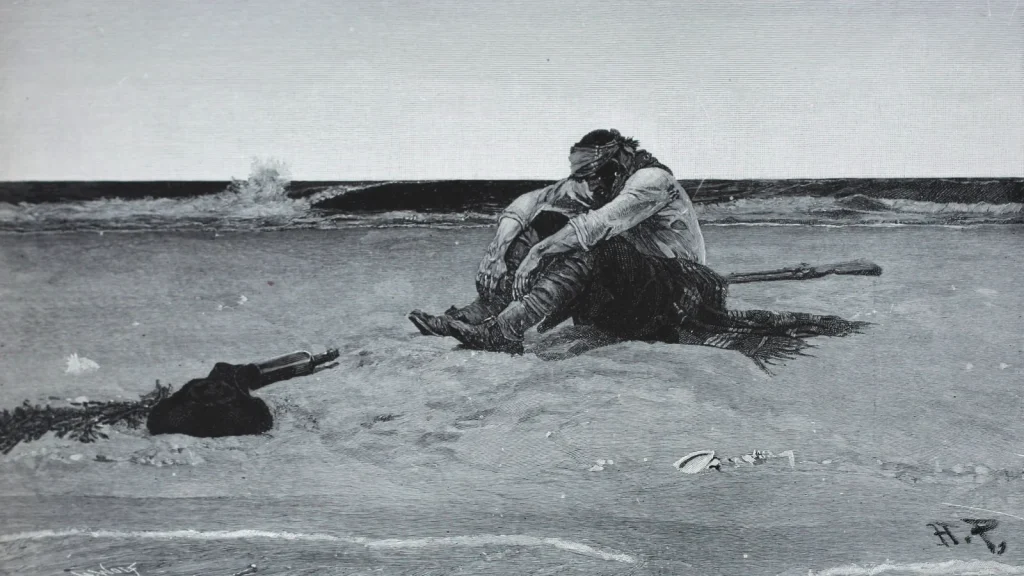
The captain’s power was real only in battle. In a chase or a fight his word was law; the rest of the time he ate the same food as his men and could be voted out at any meeting. His counterweight was the quartermaster, also elected, who divided the loot, settled disputes, led boarding parties and spoke for the crew. On a navy ship a captain could have a sailor flogged on a whim. On a pirate ship the crew decided punishments, and the worst they had was the one Howard Pyle painted: marooning, left on a sandbar with a pistol and a bottle of water.
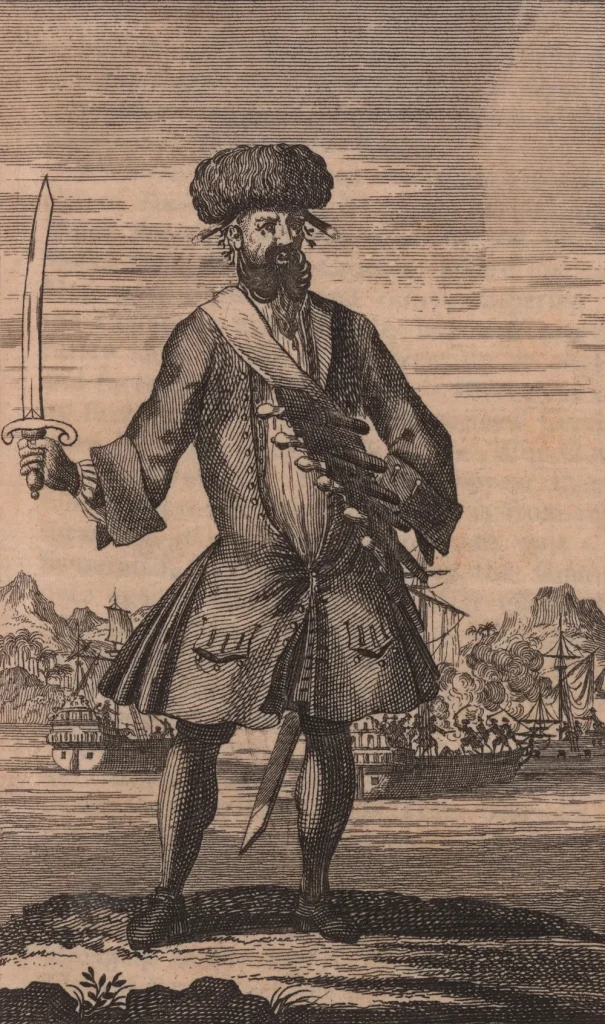
Everything ran on cash flow. A crew with no prizes had nothing to share, and soon began to ask what the captain was for. Hornigold learned this in late 1716, when his men voted him out for refusing to attack English ships, a loyalty they found quaint. Charles Vane learned it in 1718, when he declined to fight a French warship and his crew handed the captaincy to his quartermaster, Jack Rackham, and dumped Vane in a small boat. Blackbeard understood the game perfectly: his smoking fuses and bandolier of pistols were a brand, the brand made merchant crews surrender without a shot, and that kept his men rich and himself in charge.
Historians still argue over how much of this was principled rebellion and how much was simply what works when nobody can enforce a contract. Marcus Rediker, in Villains of All Nations, argues the pirates were building a deliberate alternative to the brutal hierarchy of merchant and naval life, and we think he is mostly right. Either way: a floating democracy that lived on the next prize.
Jonas lives inside exactly that bargain. In the “Jonas Betrayed” ending, he gets his crew marooned for six months, and his quartermaster, Silas, delivers the verdict with a sword at his back: the men have voted. Nothing personal. What would you do when the men who follow you can also fire you, and the severance package is your life?

The king’s pardon and the end of the republic
London’s answer was clever. In September 1717, King George I offered a full pardon to any pirate who surrendered, and Woodes Rogers, himself a former privateer, was sent to Nassau to deliver it in person. When he landed in July 1718, after Vane’s fiery exit, most of the pirates on the beach took the deal. Hornigold accepted the pardon and went to work for Rogers as a pirate hunter, chasing down his old comrades.
Rogers hanged eight holdouts on the Nassau waterfront that December, in front of their old shipmates, and the republic was finished. The rest played out fast. Blackbeard, after blockading Charleston and taking his own pardon in North Carolina, was killed in a boarding fight at Ocracoke in November 1718. Vane was caught and hanged in Jamaica. Rackham took the pardon, met Anne Bonny in Nassau, stole a sloop with her and Mary Read in 1720, and was hanged at Port Royal that November. Bonny and Read told the court they were pregnant and escaped the rope; Read died in prison, and Bonny vanished from the record, which has kept novelists busy ever since.
The Golden Age lasted barely a decade, and the Nassau republic about three years. That is why it fascinates us, and why Black Sails works. For a brief window, sailors at the bottom of the Atlantic world built the one place in the Americas where captains were elected, loot was shared and the injured were paid first. It could not last: empires do not tolerate rivals, and a democracy funded by robbery runs out of victims. But for three years on a beach in the Bahamas it was real, and Jonas, like Vane, has to decide how long to stay.
100% FREE • GRANT-FUNDED • AWARD-WINNING DIGITAL LEARNING
Empires & Interconnections (1450-1750)
Six lives in the age when the world got smaller: Ioannina inside the walls of Constantinople in 1453, Luis chasing conquistador gold in Peru in 1555, Ishi advising a warlord on the Europeans in seventeenth-century Japan, William among the first Africans sold at Jamestown in 1619, Jonas in the pirate republic of Nassau, and Arun in Mughal Bengal as the East India Company closes in. Aligned to AP World History. Best Literacy Platform at the 2024 Anthem Awards.
Educator tip: Have students read this article, then play Jonas’s chapter in Empires & Interconnections and keep a log of every choice that risks the crew’s loyalty or their share of the plunder. Close by having them draft a five-article pirate code for Jonas’s ship and defend each article with evidence from Johnson’s General History or Woodard.
Explore Empires & Interconnections
Explore the Full History Adventures Portfolio
Al-Khwarizmi Docudrama | Plague of Athens VR | Plague of Athens Web App | Black Death Interactive | Empires & Interconnections | Revolutions & Industrialization
Sources and further reading
- Stream: Black Sails (Starz, 2014 to 2017), four seasons. The prequel to Treasure Island that put Vane, Rackham, Bonny, Hornigold, Blackbeard and Woodes Rogers on screen. Rated for mature audiences.
- Stream: The Lost Pirate Kingdom (Netflix, 2021), a six-part docudrama on the Nassau republic, narrated by Derek Jacobi, with on-camera historians between the dramatized scenes.
- Watch: Golden Age of Piracy – Real Pirates of the Caribbean, Kings and Generals (YouTube). An animated documentary on how the Caribbean pirates rose and fell.
- Listen: “Life in the Pirate Republic”, Echoes of History (History Hit and Ubisoft, 2026). Host Matt Lewis asks pirate historian Dr Rebecca Simon whether Nassau’s reputation for freedom and democracy holds up.
- Play: Assassin’s Creed IV: Black Flag (Ubisoft, 2013). Sail the same Nassau of 1715 as Edward Kenway, alongside Hornigold, Thatch, Vane and Rackham.
- Read: Colin Woodard, The Republic of Pirates: Being the True and Surprising Story of the Caribbean Pirates and the Man Who Brought Them Down (Harcourt, 2007). The readable backbone of everything above.
- Read: Captain Charles Johnson, A General History of the Pyrates (1724). The original source for Blackbeard’s smoking fuses, the pirate articles, and Bonny and Read; free on Project Gutenberg.
- Read: Marcus Rediker, Villains of All Nations: Atlantic Pirates in the Golden Age (2004). The scholarly standard on pirate ships as floating democracies.
Featured image: Howard Pyle, Marooned, 1887, an illustration for “Buccaneers and Marooners of the Spanish Main” reprinted in Howard Pyle’s Book of Pirates (1921), showing the pirate crews’ harshest punishment. Public domain, via Wikimedia Commons.
By Spencer Striker, PhD, Professor of Digital Media Design at Northwestern University in Qatar, founding member of NU-Q’s Artificial Intelligence and Media Lab (AIM-LAB), and creator of History Adventures and Al-Khwarizmi: Father of Algebra & the Algorithm.