

Samarra, the night of 10 December 861. The caliph al-Mutawakkil, master on paper of an empire that runs from North Africa to Central Asia, is at supper with his favorite minister. An hour after midnight the door bursts open. The men who come through it are his own Turkish guards, the soldiers his family imported to protect the throne, and his eldest son is in on the plot. By morning the caliph is dead and the official story is that he choked on his drink.
Nobody believed it. The murder set off nine years of chaos that historians call the Anarchy at Samarra, with four caliphs killed or deposed in a row. It is also the year Ubisoft chose for Assassin’s Creed Mirage, the 2023 game that rebuilt Baghdad street by street and let millions of players climb its minarets. Here is what the game gets right about one of the greatest cities that ever existed, and why we made the same bet it did.
100% Free · Free on YouTube: 45-minute film, 30-episode vertical series, 60-second trailer
Loved running the rooftops of Baghdad in Mirage? Our docudrama Al-Khwarizmi: Father of Algebra & the Algorithm rebuilds the same city one generation earlier, inside the House of Wisdom, and it is free on YouTube as a 45-minute film and a 30-episode series. Watch the Full Film Free →
The city the Mongols erased
Start with the problem Ubisoft Bordeaux faced. Baghdad in 861 was probably the largest city on earth outside China, and almost none of it survives. The Mongols burned it in 1258, the Tigris shifted, and modern Baghdad sits on top of the rest. Art director Jean-Luc Sala has said his team’s first discovery was that nothing from the period was left to photograph.
So they rebuilt it from words. Medieval travelers and geographers described Baghdad obsessively, and the scholar Guy Le Strange turned those descriptions into maps more than a century ago. The developers worked from that material with historians on weekly calls, among them Dr. Raphaël Weyland at Ubisoft Montreal and Dr. Glaire D. Anderson of the University of Edinburgh, plus museums holding Abbasid art, including the David Collection in Copenhagen and the Institut du monde arabe in Paris.
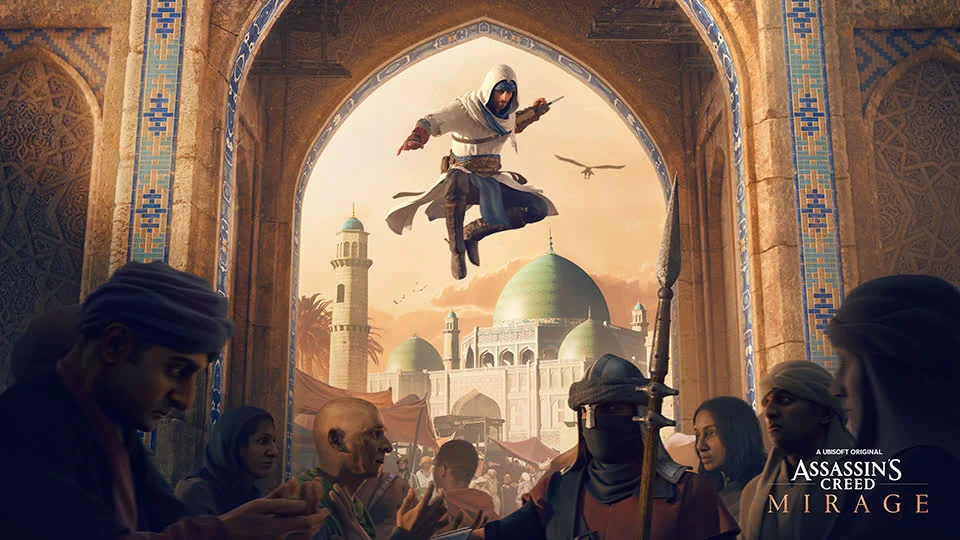
The result is a Baghdad in four districts, and the division is sound. The Round City is the walled seat of power. Karkh is the market quarter south of it, loud with traders. Harbiyah is the dense industrial north. Abbasiyah is the scholars’ district, and that is where the game puts the House of Wisdom. Beyond the walls lie canals, palm groves and smaller towns like Anbar. The game is golden, green and wet, full of fountains and gardens, which is exactly what the medieval writers describe and exactly what most people do not expect of Iraq.
Sixty-six lessons hidden in a stealth game
What makes Mirage special for teachers is the History of Baghdad feature. Visit 66 real sites across the city and you unlock short illustrated articles, written by Weyland’s team and grouped under five headings: economy, belief and daily life, government, art and science, and court life. They cover table manners, the paper trade, astronomical instruments and the five pillars of Islam, and they do not dodge harder subjects like slavery and the harem.
Then there is the sound. Mirage was the first game in the series with a full Arabic voice track, and it is classical Arabic, scrubbed of modern words, with Jordanian actor Eyad Nassar as Basim. Play it that way with subtitles and the bazaar stops being a backdrop and becomes a place. Weyland said his goal was to show Baghdad as a brilliant city of artists and scientists, and the game delivers that in costume, calligraphy and the music of Layth Sidiq.

What does the game bend? The Hidden Ones and the Order of the Ancients are fiction, al-Mutawakkil really died at Samarra and not in a palace heist at Anbar, and a city of perhaps a million people has been compressed so a thief can run across it in an afternoon. None of that spoils the achievement. It is the most ambitious popular reconstruction of Abbasid Baghdad ever attempted, and it sits inside a game people actually finish.
Ubisoft is not the only studio that rebuilt this city from nothing. We did it too, for our docudrama Al-Khwarizmi: Father of Algebra & the Algorithm, set in the same streets one generation earlier. Watch the 60-second trailer below, then keep its candlelit Baghdad in mind as we visit the real one.
The real city: paper, translators and a caliph who loved books
Now rewind one generation from the game. The city Basim runs through was built in 762 by the caliph al-Mansur as a perfect circle, with four gates named for the roads to Kufa, Basra, Khurasan and Syria, and the caliph’s palace and great mosque at the center. Within decades it had outgrown its walls. Baghdad had a paper mill by the end of the eighth century, and cheap paper did for the Abbasids what the printing press later did for Europe: it made books ordinary.
Under the caliph al-Ma’mun, who ruled from 813 to 833, the court paid for the greatest translation effort of the Middle Ages. Greek medicine, Persian astronomy and Indian arithmetic were turned into Arabic by scholars like the Christian physician Hunayn ibn Ishaq and the engineering Banu Musa brothers. Historians still argue whether the House of Wisdom was a grand academy or a palace library; the honest answer is that the name matters less than the money, and the money was real.
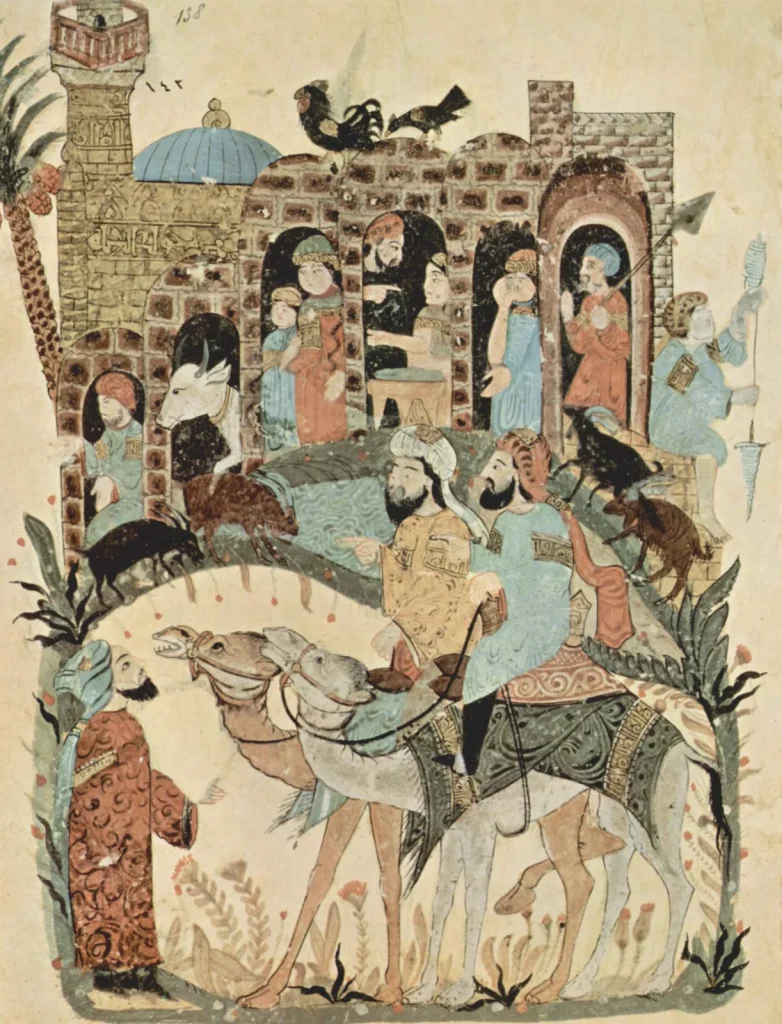
Into that city came a young mathematician from Khwarazm in Central Asia, Muhammad ibn Musa al-Khwarizmi. Sometime between 813 and 833 he wrote the book that gave us the word algebra, and his name, mangled by Latin scribes, became the word algorithm. He died around 850. Eleven years later the caliph was murdered, the army took over, and Baghdad’s golden decades began to tarnish. The game opens the day after the party ended.
Why we made the same choice Ubisoft did
We know the problem Sala’s team faced because we faced it too. When we made Al-Khwarizmi: Father of Algebra & the Algorithm, our docudrama about the man and the city, there was nothing to film. No portrait of al-Khwarizmi exists. The House of Wisdom is ash. So we did what Ubisoft did: we rebuilt a world nobody photographed, so people could see it and feel it instead of reading about it.
Our series follows al-Khwarizmi from outsider to the House of Wisdom through rival scholars, patrons and caliphs, then follows his ideas down the Silk Road into European scriptoriums and finally into the present, where the algorithm runs medicine, finance and AI. It is free on YouTube as a 45-minute film and a 30-episode vertical series, made with historians Jörg Matthias Determann, PhD, and Anto Mohsin, PhD, on camera.
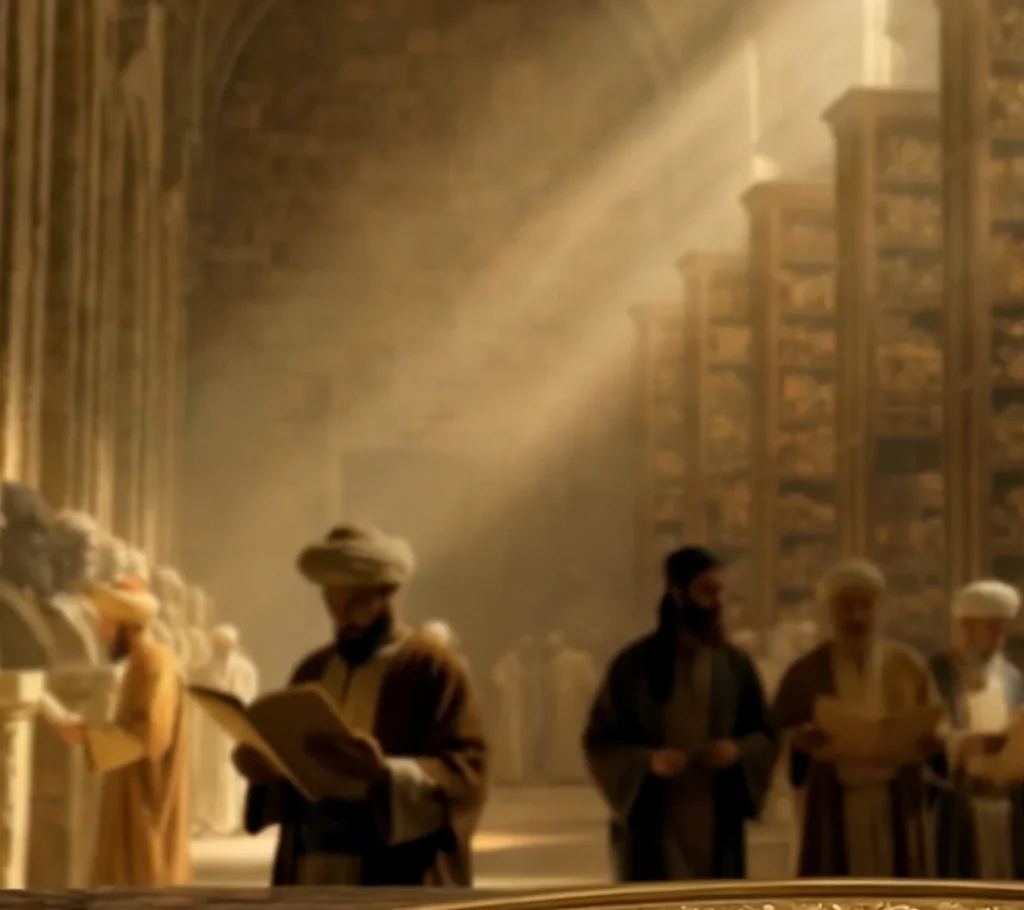
The two Baghdads look very different, and that is deliberate. Mirage is a daylight city, sun-bleached brick and turquoise tile, built so you can read a rooftop from a hundred meters away. Ours is a candlelit city. We call the style Poetic Noir Realism: baroque chiaroscuro, ink and gold, painterly texture, faces lit by a single lamp. A game needs you to see everything. A drama needs you to feel one man in one room, with the dark pressing in.
There is a twist in our method that we love. Our Baghdad was animated with generative AI, with tools like Midjourney and Kling orchestrated in the pipeline. The man whose name became the word algorithm is brought back to life by algorithms. Imagine standing in al-Ma’mun’s court with a manuscript under your arm, knowing the patron who funds you could fall tomorrow. Do you publish, or do you wait? Al-Khwarizmi published.
Play it, then watch it
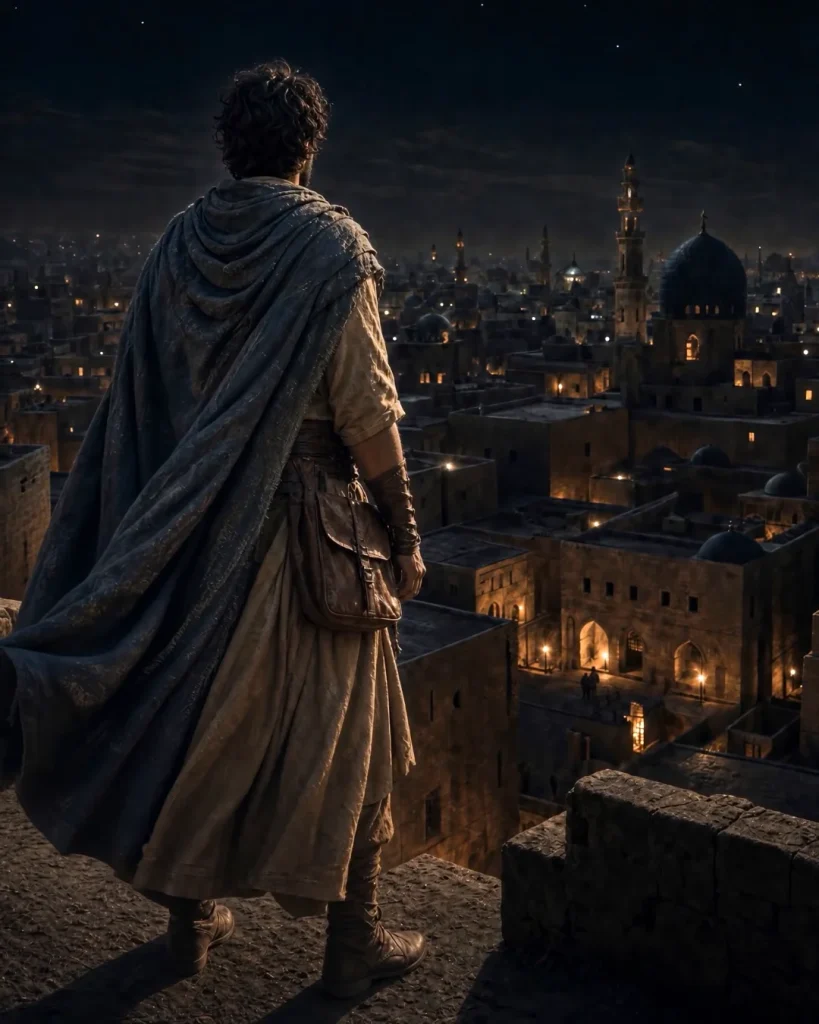
For a classroom the pairing is obvious. Let students spend an hour in Mirage with the Arabic track on, collecting History of Baghdad entries in Abbasiyah. Then screen our 45-minute film, which visits the same House of Wisdom a generation earlier and asks what was actually being written inside it. One shows the city. The other shows the idea that made the city matter.
Both are reconstructions, and both are honest about it. Baghdad in the ninth century was a real place where real people argued about Euclid by lamplight while the army plotted upriver. The game lets you run across its roofs. The film lets you sit at its desks. Together they bring back a city the Mongols thought they had erased.
100% FREE • GRANT-FUNDED • AWARD-WINNING DIGITAL LEARNING
Al-Khwarizmi: Father of Algebra & the Algorithm
An original AI-animated docudrama in the tradition of Rise of Empires: Ottoman. Follow a young outsider from Central Asia to the House of Wisdom in ninth-century Baghdad, where he fused Greek geometry and Indian arithmetic into algebra and gave the world the algorithm, told with the very technology his ideas made possible. Funded by a Doha Film Institute Web Series Grant and selected for the Qumra 2026 Series Lab, featuring historians Jörg Matthias Determann, PhD, and Anto Mohsin, PhD. Co-directed by Maha Al-Naemi. Created by Spencer Striker, PhD.
Educator tip: Have students play one hour of Assassin’s Creed Mirage with the Arabic voice track on and collect five History of Baghdad entries from the Abbasiyah district, then screen the 45-minute film Al-Khwarizmi: Father of Algebra & the Algorithm. Ask each student to write one page comparing how the game and the docudrama reconstruct the House of Wisdom and to defend which choice (daylight detail or candlelit drama) teaches them more.
Watch the Full Film Free Watch the 30-Episode Series About the Series
Explore the Full History Adventures Portfolio
Al-Khwarizmi Docudrama | Plague of Athens VR | Plague of Athens Web App | Black Death Interactive | Empires & Interconnections | Revolutions & Industrialization
Sources and further reading
- Play: Assassin’s Creed Mirage (Ubisoft Bordeaux, 2023), on PlayStation, Xbox, PC and, since 2024, iPhone and iPad. Turn on the Arabic voice track and collect the History of Baghdad entries.
- Watch: Kings and Generals, “Medieval Baghdad: Rise and Fall of the City of Peace – DOCUMENTARY” (YouTube). The Round City from al-Mansur’s founding to 1258 in one sitting.
- Watch: Al Muqaddimah, “The Anarchy at Samarra & The End of Abbasid Power | 861CE – 870CE | Abbasid Caliphate #07” (YouTube). The nine years the game is set in, explained.
- Listen: The Rest Is History, “Baghdad: Crossroads of the Universe” (episode 377, October 2023). Tom Holland and Dominic Sandbrook on how al-Mansur built a circle in the desert.
- Read: Jim Al-Khalili, The House of Wisdom: How Arabic Science Saved Ancient Knowledge and Gave Us the Renaissance (Penguin Press, 2011). The most readable tour of the translation movement and al-Khwarizmi’s Baghdad.
- Read: Hugh Kennedy, When Baghdad Ruled the Muslim World: The Rise and Fall of Islam’s Greatest Dynasty (Da Capo, 2005; first published in the UK as The Court of the Caliphs, 2004). The scholarly standard, and surprisingly fun on court intrigue.
- Read: Ubisoft, “Assassin’s Creed Mirage Introduces History of Baghdad Feature to Bring Players Closer to History” (July 2023). The historians and museums behind the game’s codex, in Ubisoft’s own words.
Featured image: ninth-century Baghdad from above, a media kit still from our AI-animated docudrama Al-Khwarizmi: Father of Algebra & the Algorithm (2026), courtesy of History Adventures, LLC, cropped to 16:9.
By Spencer Striker, PhD, Professor of Digital Media Design at Northwestern University in Qatar, founding member of NU-Q’s Artificial Intelligence and Media Lab (AIM-LAB), and creator of History Adventures and Al-Khwarizmi: Father of Algebra & the Algorithm.