
Before dawn on 29 May 1453, the largest cannon in the world fired for the last time. For seven weeks the Ottoman guns had been pounding the land walls of Constantinople, walls that had held for a thousand years, and now Sultan Mehmed II, twenty-one years old, sent everything he had at the breach. Inside the city the bells rang, and families who had not slept decided, in the dark, whether to run for the harbor or stay and pray in Hagia Sophia.
If you teach AP World History: Modern, you know that morning. It opens Unit 3, and it is where we chose to begin our app Empires & Interconnections. A young woman named Ioannina stands inside those walls, and the player has to make the call her neighbors made: stay in the city of your birth, or flee west. This post is a guide to the four units that run from that morning to 1900, what the exam really wants from each, and why a character who has to choose beats a timeline every time.
100% Free · The History Adventures collection
Our two apps, Empires & Interconnections and Revolutions & Industrialization, were built around exactly these four AP World History units, one character at every hinge point. Both are completely free for any classroom. See every free title →
Four units, half the exam
The College Board splits the modern world into nine units, and the four that cover 1450 to 1900 are the heavy ones. Land-Based Empires (Unit 3) and Transoceanic Interconnections (Unit 4) share c. 1450 to c. 1750. Revolutions (Unit 5) and Consequences of Industrialization (Unit 6) share c. 1750 to c. 1900. Each is weighted at 12 to 15 percent of the exam score, so together they are worth about half the test.
Units 3 and 4: the world gets smaller
Unit 3 is about gunpowder and glue. The Ottomans, Safavids and Mughals conquered enormous territories with cannon and cavalry, then faced the harder problem of holding them. The exam loves the glue: the devshirme that turned Christian boys into janissaries, the Mughal zamindars who collected the taxes, Louis XIV at Versailles. Then belief: a Reformation splitting Europe, Sunni Ottomans glaring at Shia Safavids across a hostile border, Sikhism rising in the Punjab.
Unit 4 is the ocean. Europeans borrowed the compass from China and the astrolabe from the Islamic world, built the caravel, and found the winds. What followed is the most-tested idea in the course: the Columbian Exchange. Smallpox went west and emptied cities; potatoes and maize went east and fed the population booms of Ireland and China. Silver from Potosí crossed the Pacific on the Manila galleons to a Ming China that wanted its taxes paid in silver. More than twelve million Africans were shipped across the Atlantic in chains, the largest forced migration in history. Students also need resistance, from the Pueblo Revolt to maroon communities, and the great exception, Tokugawa Japan, which expelled the missionaries and penned the Europeans on one island in Nagasaki harbor.
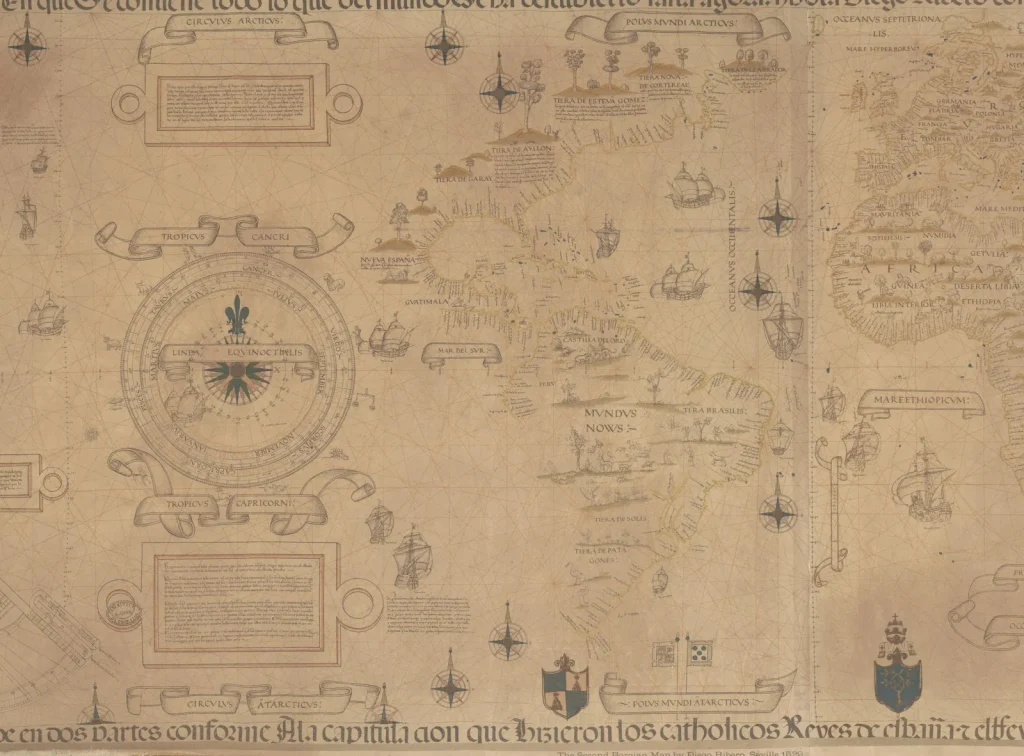
We built Empires & Interconnections as six lives dropped into exactly these pages. Ioannina watches the walls of Constantinople crumble in 1453. Luis rides into Peru in 1555 chasing conquistador gold, a late-wave adventurer a day late and a dollar short, who meets disease, war and madness instead. Ishi counsels a warlord in 1603 on the European missionaries, and his advice tips Japan toward engagement or isolation. William is among the first Africans sold at Jamestown in 1619. Jonas lives free in the pirate republic of Nassau, one step ahead of the hangman. And Arun, in 1750s Bengal, is a zamindar, the exact word in the course framework, torn between a weakening Mughal Empire and the East India Company at his door.

Students pick a life by spinning a globe, then step into 360-degree panoramas, make the decisions, read enhanced primary documents, and trace animated maps of the Atlantic slave trade, Japan and India.
Units 5 and 6: the century that would not sit still
Unit 5 opens with an argument. Locke says rulers govern by consent. Rousseau says the people are sovereign. Wollstonecraft asks why none of this applies to women. Then the argument catches fire: the thirteen colonies in 1776, France in 1789, Haiti from 1791, Bolívar across South America. The second half of the unit is coal. Britain industrialized first because it had coal, rivers, capital, colonies and an agricultural revolution that freed hands for the mills; the United States, Germany, Russia and Meiji Japan followed. Then the responses: trade unions, Marx, factory acts, a new middle class, and the question our app Revolutions & Industrialization puts at its center: were the advances of 1750 to 1900 worth the human cost?
Unit 6 is the bill. Industrial nations needed raw materials and markets, and found a vocabulary to justify taking them: the civilizing mission, social Darwinism, Kipling’s poem of 1899. Africa was carved up on a table in Berlin in 1884 and 1885; King Leopold II ran the Congo as a private rubber plantation; Britain took direct control of India after 1857 and filled Australia with settlers. Where it could not conquer, it bought: the Opium Wars are the textbook case of economic imperialism. Students must also know the responses, from the 1857 rebellion to Samory Touré, and the migrations, from Indian indentured laborers to the Chinese Exclusion Act of 1882.

Revolutions & Industrialization, the first title in our World of Characters series, follows five people through these two units. Agent 355 is an enslaved woman turned spy for the Culper Ring in 1778, risking everything for freedom in a nation fighting for liberty while upholding slavery. Jiemba is an Eora man watching the British land at Botany Bay in 1788. Fei Hong is a woodcarver in 1840s China pulled into opium smuggling as war looms. Khari leads resistance to Leopold’s rubber regime in the 1890s Congo. Thomas Brown, in 1899, disguises himself as a janitor to expose Chicago’s meatpacking plants, a muckraker in the mold of Upton Sinclair. For APUSH teachers, Agent 355 lands in Period 3 (1754 to 1800) and Thomas Brown at the seam between the Gilded Age and the Progressive Era. A word of honesty: the app does not cover the Haitian Revolution, the French Revolution or Napoleon. It explores the same era and the same kinds of choices through other eyes.
Why students remember people, not periods
Give a class six dates on Monday and ask for them back on Friday. Then tell them about a girl deciding whether to run for the harbor. You already know which one survives the weekend. Working memory is small, and a list of dates offers it nothing to hold onto. A story offers a person, a problem, and a reason to care what happens next. The cognitive scientist Daniel Willingham calls stories “psychologically privileged” in memory, and any teacher who has watched a room go quiet for a good one knows he is right.
Sam Wineburg makes the other half of the argument in Why Learn History (When It’s Already on Your Phone): knowing facts is not the same as thinking historically. Historians ask who wrote a document, when, and why. A character at a hinge point does both jobs at once. Students remember Arun because they were Arun, and they understand the East India Company because they had to decide whether to trust it.

That is why every chapter we build ends at a fork, and why the question on our blackboard is always the same: what would I have done? Picture Ishi in 1603, kneeling before a warlord who has just asked whether the foreign priests should stay. Your student has to weigh the silver trade, the muskets and the converts in Kyushu in a single answer. Would you tell him to open the door, or shut it? Either way, they will remember why Japan chose as it did.

Three ways to run it in class
A DBQ warm-up. Before the year’s first DBQ, send students into Arun’s chapter of Empires & Interconnections to work through the enhanced primary documents on the East India Company. Ten minutes of sourcing inside a story they care about, then a thesis on the board. We do not ship a DBQ. We ship the documents and the reason to read them.
A character-choice debate. Split the room before anyone plays Ishi. One side argues for welcoming the missionaries, the other for expelling them. Let them play, then compare what they chose to what the Tokugawa shogunate actually did. The gap between the two is the lesson.
A comparison across two characters. Pair Arun in 1750s Bengal with Jiemba at Botany Bay in 1788: the British Empire arriving on two shores, once as a trading company and once as a fleet of convict ships. Ask what each man could see coming and what each could do about it. That is a comparison essay built from two lives instead of two textbook paragraphs.
Both apps are completely free. On the morning of 29 May 1453, Ioannina’s neighbors had to decide. So does every student who meets her, and that is the whole course in one question.
100% FREE • GRANT-FUNDED • AWARD-WINNING DIGITAL LEARNING
The History Adventures Collection
Educator tip: Assign this article as the unit opener, then have each student play one character from Empires & Interconnections or Revolutions & Industrialization and write a one-page comparison of that character’s choice with the real decision made at the same moment in the unit. Finish with a class debate on whether the character chose well.
Empires & Interconnections (1450-1750) (iPad app, Android tablet app, and Apple Books interactive edition)
Explore Empires & Interconnections
Revolutions & Industrialization (1750-1900) (Apple Books interactive edition and Chromebook web app)
Explore Revolutions & Industrialization
Explore the Full History Adventures Portfolio
Al-Khwarizmi Docudrama | Plague of Athens VR | Plague of Athens Web App | Black Death Interactive | Empires & Interconnections | Revolutions & Industrialization
Sources and further reading
- Read: College Board, AP World History: Modern Course and Exam Description. The official framework for all nine units, with every key concept and the exam format.
- Read: Sam Wineburg, Why Learn History (When It’s Already on Your Phone) (University of Chicago Press, 2018). The case that historical thinking, not memorization, is what the subject is for.
- Watch: Heimler’s History, AP World UNIT 3 REVIEW [Everything You NEED to Know!] (YouTube). Steve Heimler’s fast, funny tour of the land-based empires.
- Watch: CrashCourse, The Columbian Exchange: Crash Course World History #23 (YouTube). John Green on the most-tested idea in Unit 4.
- Watch: CrashCourse, Coal, Steam, and The Industrial Revolution: Crash Course World History #32 (YouTube). Why Britain went first, and what it cost.
- Listen: AP History Help (podcast, hosted by Wendy, a veteran educator). Weekly fifteen-minute episodes on the rubrics and themes shared by AP World, APUSH and AP Euro.
- Play: Empires & Interconnections (1450-1750), our free app for iPad, Android tablets and Apple Books, aligned to Units 3 and 4.
- Play: Revolutions & Industrialization (1750-1900), our free Apple Books edition and Chromebook web app, aligned to Units 5 and 6.
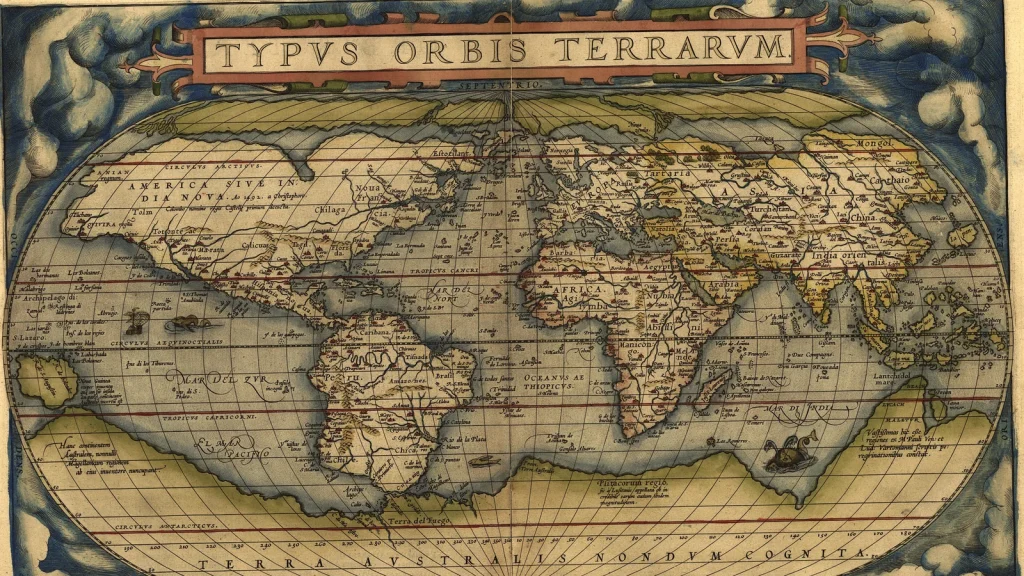
Featured image: Abraham Ortelius, Typus Orbis Terrarum, 1570, the world map from his Theatrum Orbis Terrarum, engraved by Frans Hogenberg, hand-colored. Public domain, via Wikimedia Commons (cropped).